
TL;DR
- How to rank in ChatGPT answers is different from ranking in Google.
- AI systems retrieve and synthesize information instead of simply ranking web pages.
- Clear answers, structured content, and consistent brand signals matter more than keyword density.
- One client increased their AI citation count by more than 100 in just seven days using this approach.
- AI visibility comes from building repeatable systems, not chasing one viral page or quick win.
- Start by making your content easier for both people and AI systems to understand.
A few weeks ago, I made a series of structured SEO changes for a client. Within seven days, their AI citation count increased by more than 100.
That result wasn’t luck, and it wasn’t because I found a secret ChatGPT hack. It happened because we stopped treating AI search like traditional SEO and started optimizing for how large language models actually retrieve, understand, and cite information.
That is the biggest mistake I see right now. Most people assume that if they rank well in Google, they will automatically show up in ChatGPT answers. While there is overlap between the two, they do not work the same way.
Search engines rank web pages. AI systems generate answers by retrieving and synthesizing information from multiple trusted sources. That changes what matters. Success is no longer just about keywords or backlinks. It depends on whether your content is structured, understandable, trustworthy, and easy for AI systems to extract accurately.
In this post, I will explain the framework I use to improve AI visibility for clients, why it works, and what I have learned from helping websites earn more citations in AI generated answers. I will share the principles behind the approach while keeping the implementation details where they belong.
How Is Ranking in ChatGPT Different From Ranking in Google?
If you want to know how to rank in ChatGPT answers, the first thing you need to understand is that ChatGPT is not a search engine.
Google ranks web pages and presents them as a list of search results. ChatGPT generates a direct answer by retrieving and synthesizing information from multiple trusted sources. In many cases, it can also use live web search to support its responses.
That difference changes how you should think about visibility. Ranking in Google is about earning a position on a search results page. Getting mentioned in ChatGPT is about becoming a source worth citing.
There is still overlap between traditional SEO and AI visibility. Strong technical SEO, authoritative content, and trustworthy websites matter in both. The difference is that AI systems place much more emphasis on how clearly information is presented, how consistently your brand appears across the web, and how easy it is to understand and extract your content.
That is why optimizing for AI search requires a different mindset. The goal is not simply to rank a page. The goal is to create content that AI systems can confidently understand, trust, and reference.
| Google Search | ChatGPT |
|---|---|
| Ranks web pages | Generates direct answers |
| Returns a list of search results | Synthesizes information from multiple trusted sources |
| Success depends on ranking position | Success depends on being a source worth citing |
| Optimizes for clicks | Optimizes for answer quality and relevance |
| Focuses on keywords, links, and authority | Focuses on clarity, structure, authority, and consistent entity signals |
How to Rank in ChatGPT Answers: The Actual Mechanics
If ChatGPT doesn’t rank websites the same way Google does, what does it actually look for?
From my experience, AI systems don’t just look at whether a page exists. They look at how easy it is to understand, whether the information is consistent with what other trusted sources say, and whether the content is worth referencing in the first place.
That means the goal isn’t simply to publish more content. It’s to publish content that is clear, structured, and supported by signals that reinforce your authority.
These are the principles I focus on when improving a client’s AI visibility.
1. Make your answers easy to extract
One pattern I’ve seen repeatedly is that AI systems respond better to content that answers the question immediately.
Instead of spending several paragraphs building up to the point, every section should answer the question first and then explain it. Readers get what they came for faster, and AI systems have a much easier time identifying the information they’re looking for.
For example, if your heading asks, Does schema markup matter for AI search?, the first sentence underneath should answer that question directly before you explain the reasoning.
2. Standardize your structured data
If you’ve never touched structured data before, here’s the simple version. It’s a small block of code added to a webpage that spells out, in a language machines understand, what the page is actually about. Think of it like a label on a product versus the product itself.
A person can look at a bottle and tell it’s shampoo. A machine can’t infer that as easily, so the label states it directly: this is a product, its name is X, its price is Y, its rating is Z. Structured data does the same thing for your content.
An Article schema, for example, can explicitly tag the headline, the author, the publish date, and the main image, so an AI system doesn’t have to guess who wrote a piece or when it was published, it’s stated in a format built for machines to read.
I standardize structured data across a client’s entire content library, not just one page, so machines have a consistent, reliable way to parse what every page is actually about. This matters because AI systems are trying to extract meaning at scale. A page that’s clearly marked up is far easier to trust and reference than one where the system has to guess.
3. Build visibility beyond your own website
AI systems don’t just evaluate what you say about yourself, they weigh what other sources say about you too. That’s why I deliberately increase high-quality third-party mentions across relevant communities to strengthen brand recognition outside the client’s own website.
A brand that only exists on its own domain looks a lot less trustworthy to an AI system than one that shows up consistently across other credible spaces. I won’t get into the specific platforms, the exact volume, or how fast this can move, because that’s the execution layer, but the principle holds regardless of the brand: visibility off your site reinforces authority on it.
4. Keep your entity consistent everywhere
This one gets overlooked constantly. Entity consistency means the facts about a brand, who you are, what you do, what you’re known for, stay identical across every platform where it appears. AI systems are building an internal understanding of who you are based on patterns across the web.
If your bio says one thing on your website, another on LinkedIn, and something else on a directory listing, you’re actively working against yourself. Consistency is what lets that understanding solidify instead of staying fuzzy.
5. Publish something that doesn’t already exist
The last principle is the one people underestimate the most: information gain. Publishing original examples, real client observations, frameworks you built yourself, and actual data from actual experiments is far more likely to get cited than generic advice.
Generic “10 tips” content already exists a thousand times over, and AI systems have no reason to reference yours specifically. This is one of the biggest differences between average content and content that actually gets cited.
If your content doesn’t add anything the model hasn’t already seen elsewhere, there’s nothing pulling it toward you as the source.
Why One Blog Post Won’t Get You Into ChatGPT Answers
One of the biggest misconceptions about AI visibility is that a single well-written article is enough to start showing up in ChatGPT answers.
It usually isn’t.
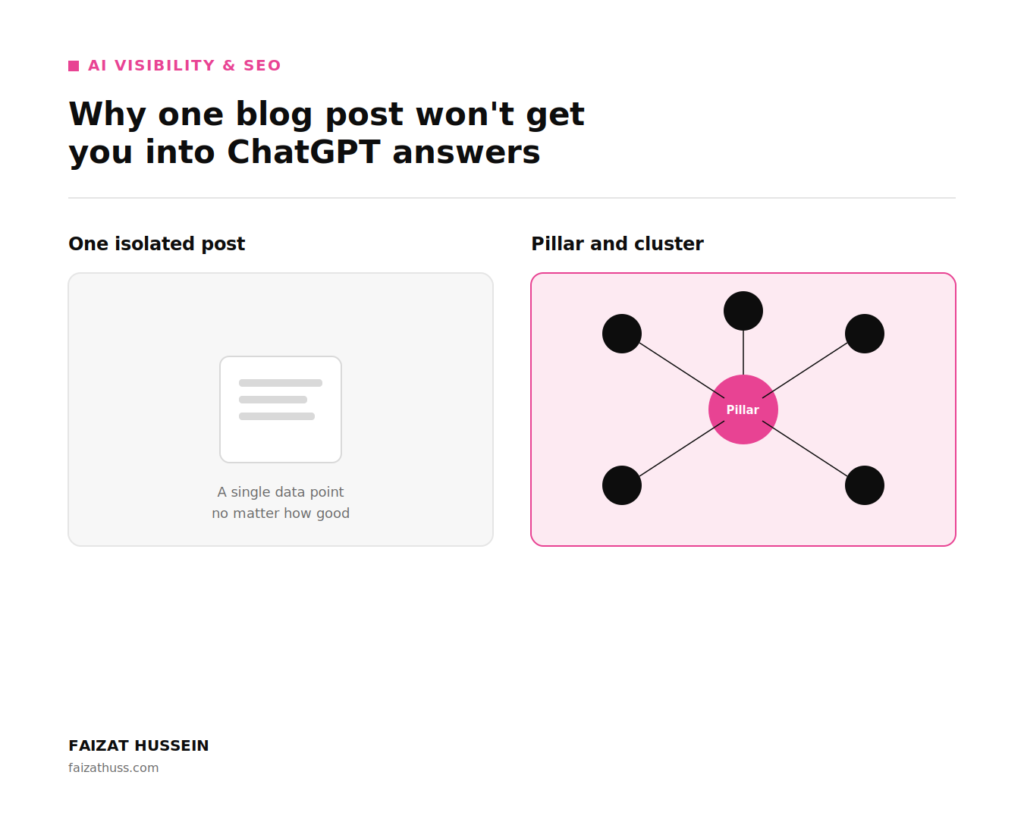
AI systems don’t just evaluate individual pages. They build an understanding of whether a website consistently demonstrates expertise on a topic. That’s where topical authority comes in.
If your website has one excellent article about AI search optimization but nothing else supporting that topic, it’s much harder for AI systems to see you as a reliable source. Compare that to a website with a connected group of articles covering AI visibility, schema markup, entity optimization, retrieval, and AI search strategy from different angles. That second website sends a much stronger signal.
This is exactly why I organize content around pillar pages and supporting clusters instead of publishing disconnected blog posts whenever inspiration strikes.
Each article reinforces the others. Together, they create a body of work that makes it much easier for both people and AI systems to understand what the site is actually known for.
That’s the difference between publishing content and building authority.
How I Get Myself and Clients to Rank Using This Strategy
Everything I’ve shared in this article comes from client work.
One recent project was for a proofreading company. The goal was to improve how the website communicated its expertise so it could build stronger visibility across both search engines and AI search.
Within a month, the website ranked for 131 new keywords. Even more importantly, 62 of those keywords were commercial or transactional, putting the business in front of people actively looking for proofreading services and comparing solutions.
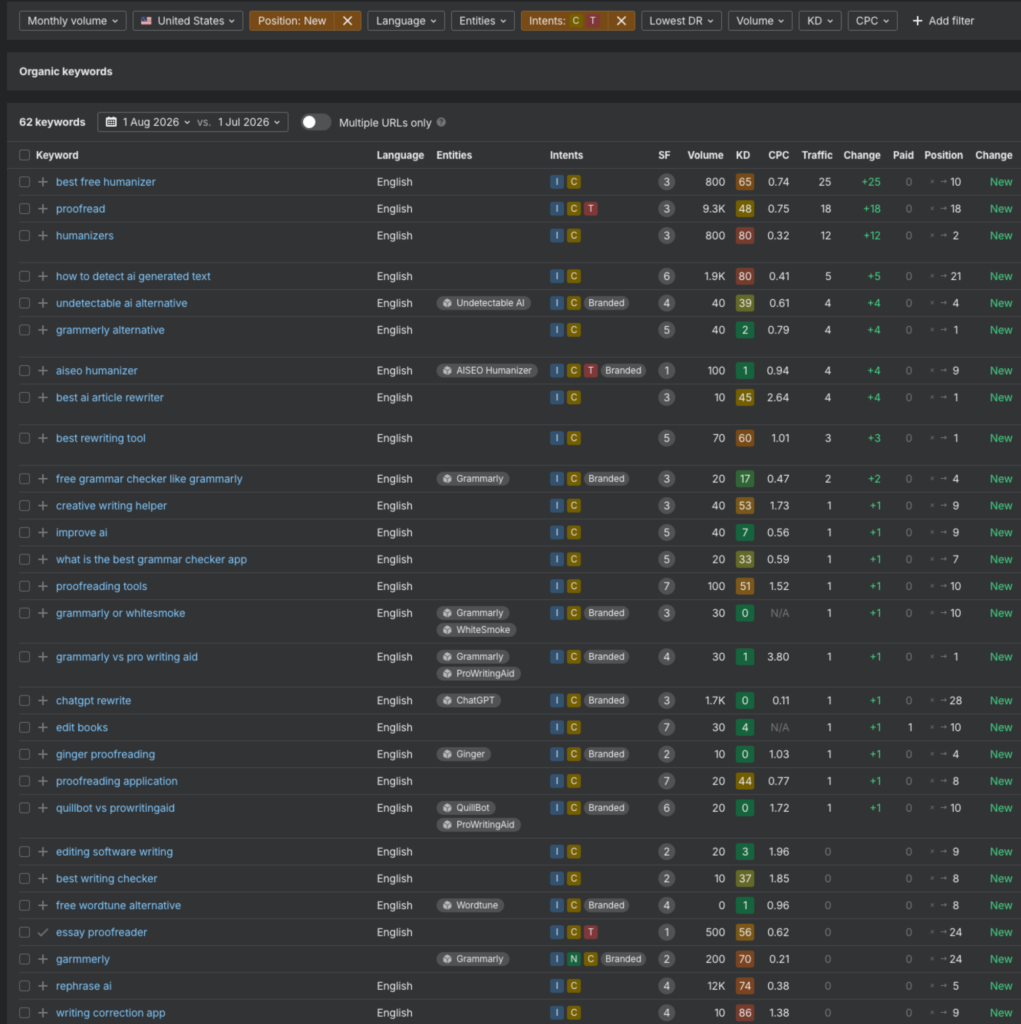
Results like these come from building strong foundations. Clear, direct-answer content, consistent entity signals, structured data, off-site brand visibility, and topical authority all reinforce each other over time.
The exact implementation changes from one client to another because every website starts in a different place. The principles stay the same. That’s why I focus on building systems that compound instead of isolated optimizations.
Does Schema Markup Still Matter for AI Search?
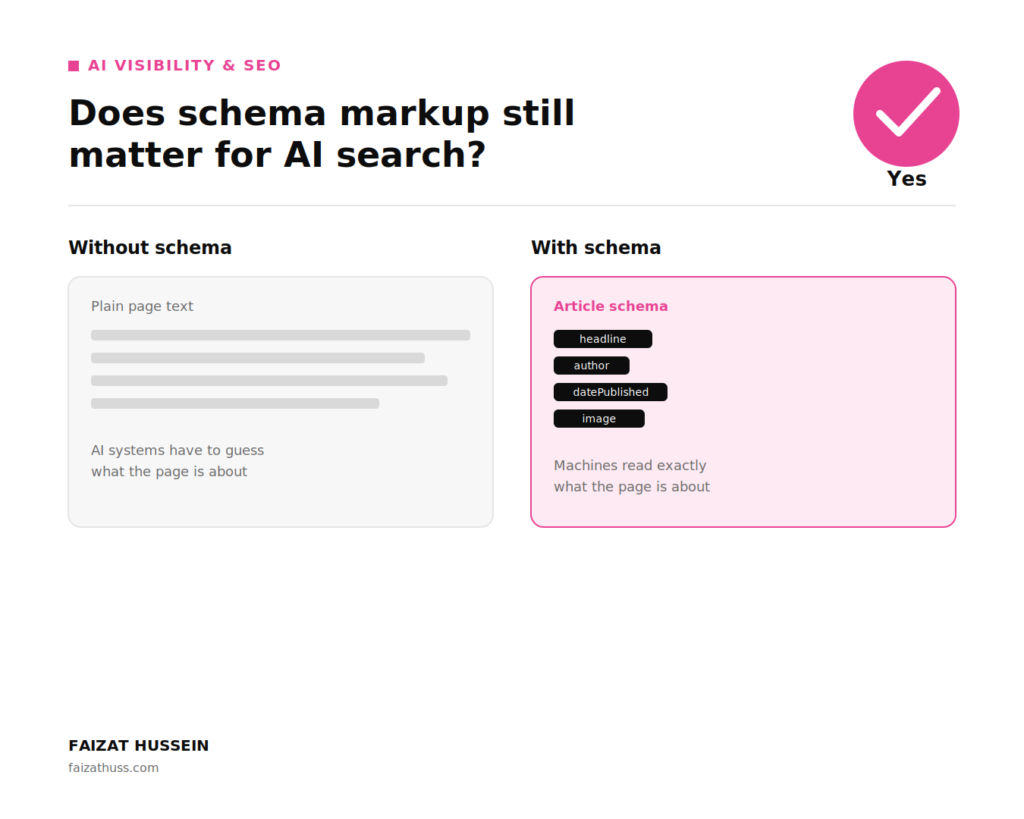
Yes. Schema markup still matters because it helps machines understand what a page is about more accurately.
Schema is structured data, a standardized way of describing information on a webpage so machines don’t have to infer everything from the visible content alone. Instead of guessing who wrote an article or what type of page it’s looking at, that information is clearly defined in a machine-readable format.
When I work with clients, we standardize structured data across the content library instead of treating it as a one-page optimization. That creates a consistent layer of information that helps machines parse the site more reliably.
Schema alone won’t get you cited in ChatGPT answers.
But when it’s combined with clear writing, strong topical authority, and consistent brand signals, it becomes another piece of a much stronger AI visibility system.
What Most People Get Wrong About AI Search Optimization
Most AI search advice focuses on tactics. In my experience, the bigger problem is strategy.
Here are the mistakes I see most often:
- Treating AI search optimization like traditional SEO with a different name.
- Publishing generic content that adds nothing new to the conversation.
- Optimizing individual pages without building topical authority.
- Sending mixed brand signals across websites, social profiles, and directories.
- Assuming rankings automatically lead to AI citations.
- Measuring success with traffic alone instead of visibility across AI search and commercial search intent.
The websites seeing consistent results are the ones that communicate expertise clearly, reinforce it across multiple sources, and make it easy for AI systems to understand what they should be known for.
Should You Hire Someone for AI Search Optimization?
You can absolutely improve your AI visibility yourself. Understanding how AI systems retrieve and evaluate information already puts you ahead of most businesses.
If you want expert direction, my One-Time AI Visibility Strategy Session and SEO Audit will give you a clear roadmap, highlight the biggest opportunities, and show you what to prioritize first. You can then implement the recommendations yourself at your own pace.
If you’d rather have someone handle the execution, I also work with clients to implement the strategy and build AI visibility as part of a long-term SEO system.
Whether you choose guidance or full execution depends on your time, resources, and goals. The important thing is having a strategy that builds authority over time.
Final Thoughts
Ranking in ChatGPT answers comes down to one thing: becoming a source AI systems can confidently understand, trust, and cite. That happens through clear content, strong topical authority, consistent entity signals, and brand visibility that extends beyond your own website. These principles have produced measurable results for my clients, and they’ll continue to shape how I approach AI visibility as search evolves.

Frequently Asked Questions
Make your content easy to retrieve, understand, and trust. Use direct-answer formatting, organize your content around topics, keep your brand information consistent across every platform, and strengthen your authority with high-quality mentions beyond your own website. AI systems evaluate the complete picture, not just individual pages.
No. Traditional SEO focuses on ranking web pages in search results, while ChatGPT retrieves and synthesizes information from multiple trusted sources to generate an answer. Strong SEO still matters, but AI visibility also depends on content clarity, entity consistency, and topical authority.
Yes. Schema markup helps machines understand your content by clearly describing what each page is about. It supports retrieval and improves how AI systems interpret your website. Combined with direct-answer content and strong authority signals, it becomes an important part of AI visibility.
Meaningful improvements can happen quickly when the right foundations are in place. One client I worked with increased their AI citation count by more than 100 within seven days after implementing structured content and site improvements. Long-term authority continues to build as those signals compound.
I’m applying the same AI visibility system to faizathuss.com, documenting the results as the site grows. That includes building topical authority, strengthening entity signals, publishing original research, and sharing what works through real implementation instead of theory.