
Nobody finds you because they know your name. They find you because they were looking for a problem you solve.
That’s why I’ve never understood the obsession with building a personal brand while ignoring personal brand SEO. Somewhere along the way, we started confusing visibility with popularity.
We celebrate follower counts, polished LinkedIn profiles, and consistent posting as proof that a personal brand is working. Then we wonder why opportunities still depend on the algorithm putting our content in front of the same audience. Most people don’t have a personal branding problem. They have a discoverability problem.
If someone has never heard of you before today, how exactly are they supposed to find you? That’s the distinction this article explores: having a personal brand isn’t the same as being discoverable. Recognition and discoverability are related, but they’re not the same thing. And if you optimize for one while ignoring the other, you’ll keep building a brand that the people who already know you admire, while the people looking for exactly what you do never find you.
TL;DR
-
- A personal brand shapes your reputation. Personal brand SEO shapes your discoverability.
-
- Discoverability determines whether people can find your expertise through search engines and AI.
-
- Consistent positioning, an owned website, search-focused content, topical authority, and clear credibility signals strengthen your online presence.
-
- Better discoverability helps recruiters, founders, journalists, podcast hosts, potential clients, and AI search engines surface your expertise.
-
- Personal brand SEO creates more opportunities by making your expertise easier to find when people are actively looking for it.
-
- Want to become more discoverable? Book a 1:1 Personal Branding Consultation to uncover what’s limiting your visibility and build a strategy that helps the right people find your expertise.
Having a Brand Isn’t the Same as Being Findable
People often use personal brand and personal brand SEO interchangeably, but they solve two completely different problems.
A personal brand is about recognition. It’s how people perceive you once they’ve already found you. It’s the reputation you build, the impression you leave, and what people associate with your name.
Personal brand SEO is different. It answers a question that comes much earlier in the journey: can someone who has never heard of you find you when they’re looking for the problem you solve?
That’s where many personal brands fall apart.
Someone can have a polished LinkedIn profile, thousands of followers, and a steady stream of content, yet remain invisible to the people actively searching for their expertise. Recognition only matters after discovery. If no one discovers you in the first place, there’s nothing to recognize.
The mistake is assuming that because your audience knows who you are, everyone else can find you too. They can’t.
| Personal Brand | Personal Brand SEO |
| Builds recognition | Builds discoverability |
| Shapes perception | Increases findability |
| Speaks to people who already know you | Connects you with people who don’t know you yet |
| Helps people remember your name | Helps strangers discover your expertise |
Understanding that distinction changes how you think about building authority online. It shifts the goal from simply being known to being found.
Why Most Personal Brand SEO Efforts Fail
Most people struggle with personal brand SEO because they send mixed signals about who they are and what they want to be known for.

Every few months, they rewrite their headline, update their positioning, or introduce themselves differently. Reinvention feels like growth, but constant changes make it harder for search engines and AI systems to confidently associate someone with a specific area of expertise.
I have also done the same and that is why I knew I was doing something wrong.
Then there’s the platform problem.
For many professionals, their entire online presence lives on LinkedIn, Instagram, or X. Those platforms are excellent for reaching an existing audience, but they’re not designed to become the definitive source of truth about your expertise. When you don’t have an owned, indexable website bringing everything together, your authority becomes scattered across platforms you don’t control.
Content strategy creates another blind spot.
A lot of people write for engagement instead of discoverability. They create posts that resonate with followers who already understand their work, rather than content that answers the questions strangers are typing into Google or asking AI assistants. Those are two very different audiences with two very different intentions.
Language matters just as much.
People naturally describe themselves using the words they like: creative titles, unique positioning statements, or phrases that feel original. Potential clients don’t search using those words. They search using the language of the problem they’re trying to solve. When those two don’t match, discoverability suffers.
The final piece is consistency.
Your website says one thing. Your LinkedIn headline says another. Your speaker bio introduces you differently again. None of those descriptions are necessarily wrong, but together they create an inconsistent picture of your expertise. Search engines and AI look for consistency. The clearer and more consistent your signals are, the easier it is for them to understand what you’re known for.
That’s why personal brand SEO isn’t just about publishing more content. It’s about creating enough consistency that both people and search engines know exactly what you should be found for.
Recognition Doesn’t Guarantee Discoverability
Recognition and discoverability are often treated as if they’re the same thing. They aren’t.
Recognition is earned after someone knows who you are. It’s built through your reputation, your content, your speaking engagements, and the work you’ve done over time. It’s why someone remembers your name or recommends you to a colleague.
Discoverability comes much earlier. It’s about whether someone who has never heard of you can find you when they’re looking for the problem you solve.
That’s the lens I use when evaluating personal brand SEO.
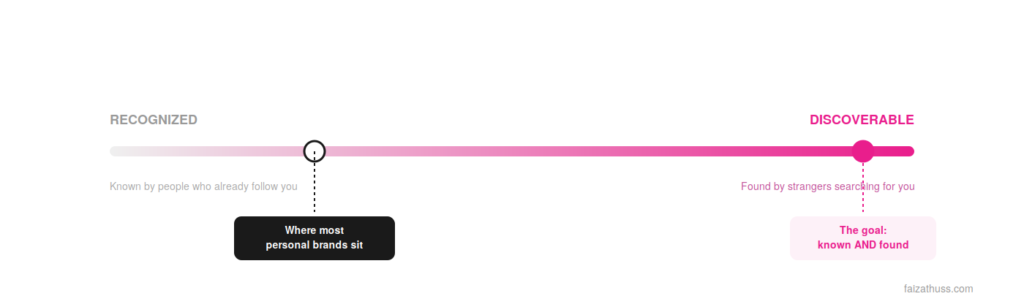
Some people have high recognition and low discoverability. They’re respected within their industry, active on social media, and known by their network. Yet someone searching for their expertise on Google or asking ChatGPT for recommendations is unlikely to find them.
The strongest personal brands have both. They’re recognized by the people who already know them and discoverable to the people who don’t.
Moving from one to the other isn’t about becoming louder online. It’s about becoming easier to understand. Consistent positioning, an owned website, and content built around real search behaviour all make it easier for search engines, AI systems, and people to connect your name with your expertise.
What Actually Fixes This
There’s no single tactic that fixes personal brand SEO. Discoverability is built through dozens of signals that work together over time. Every page you publish, every profile you update, every bio you write, and every piece of content you create contributes to how search engines and AI understand who you are and what you should be known for.
Instead of looking for shortcuts, focus on building a personal brand that consistently reinforces the same story across the web.
| What helps a personal brand rank | Why it matters |
| Consistent positioning | Repeating the same expertise and messaging helps search engines and AI associate you with a specific topic instead of several different ones. |
| An owned website | Your website becomes the central source of truth that supports everything you publish elsewhere. |
| Search-focused content | Writing about the questions your audience is already searching for makes your expertise easier to discover. |
| Entity consistency | Your website, LinkedIn profile, speaker bio, and other platforms should reinforce the same identity instead of describing different versions of you. |
| Clear site structure | Organizing your expertise into logical pages and content clusters helps search engines understand the relationship between your topics. |
| Topical authority | Publishing consistently around one area of expertise builds stronger associations than covering unrelated subjects. |
| Credibility signals | Case studies, media mentions, podcast appearances, speaking engagements, testimonials, and other third-party validation strengthen your authority. |
| Technical SEO | Fast pages, internal linking, structured data, and crawlable content make it easier for search engines to understand and surface your website. |
None of these works particularly well on its own. The real advantage comes when they reinforce one another. That’s what personal brand SEO is really about. Not chasing rankings, but creating enough clarity and consistency that search engines, AI systems, and the people using them understand exactly who you are, what you do, and when your expertise is relevant.
What Changes When Discoverability Improves
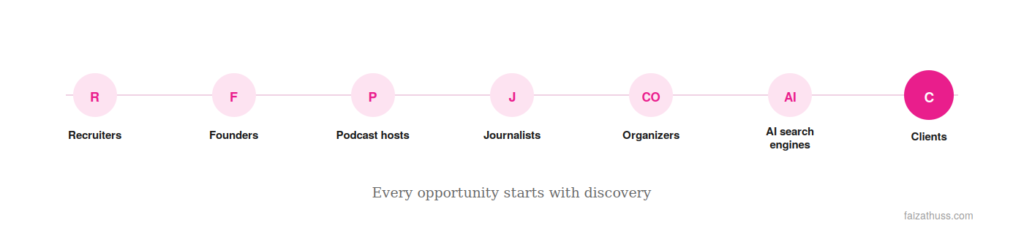
Every opportunity starts with discovery.
Before someone hires you, invites you to speak, quotes your work, or recommends your expertise, they have to find you.
When you’re easy to find, opportunities stop depending entirely on referrals, networking, or whether one of your posts happens to perform well. Your expertise becomes accessible to people who were already looking for someone like you.
That creates opportunities you can’t predict or manufacture.
-
- Recruiters can find you when they’re searching for someone with your skills and experience.
-
- Founders can discover your expertise while looking for solutions to a problem they’re trying to solve.
-
- Podcast hosts can invite you as a guest because your content demonstrates that you’re the right person to speak on a topic.
-
- Journalists can quote your insights when they’re looking for expert perspectives or credible sources.
-
- Conference organizers can find potential speakers without relying on recommendations from their network.
-
- AI search engines are more likely to surface your content when someone asks questions related to your expertise.
-
- Potential clients can discover you before they’re ready to buy, giving you the chance to build trust long before the first conversation.
-
- Your content keeps creating opportunities long after you publish it because it’s designed to be found, not just consumed in a social media feed.
That’s the real value of discoverability. It expands the number of people who can find you, trust you, and create opportunities you never had to chase.
Final Thoughts
A strong personal brand shouldn’t depend on who already knows your name. It should help the right people discover your expertise.
The internet has changed how people discover experts.
They don’t always ask for recommendations first. They search Google. They ask ChatGPT. They read articles, compare websites, browse LinkedIn profiles, and look for someone whose expertise matches the problem they’re trying to solve.
The question isn’t whether you’re good at what you do.
The question is whether the people looking for your expertise can actually find you.
If your answer is “I’m not sure,” that’s exactly where we should start.
My 1:1 Personal Branding Consultation is designed to uncover what’s limiting your discoverability and help you build a personal brand that’s positioned to be found by the right people, through search engines, AI search, and beyond.
If you’re ready to stop relying solely on referrals and start building a personal brand that’s discoverable by design, book your consultation today.