
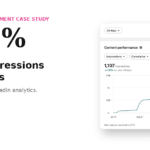
LinkedIn Management Case Study: 137% More Impressions in 28 Days
TL;DR
- In 28 days, LinkedIn impressions increased by 137% with just six posts published.
- The difference wasn’t posting more. We stuck to two posts a week and focused on content that actually gave people a reason to pay attention: client proof and useful, problem-led posts.
- The shift was pretty clear. Before this strategy, four of her posts averaged 6.5 impressions. This month, her top three posts averaged 157 impressions.
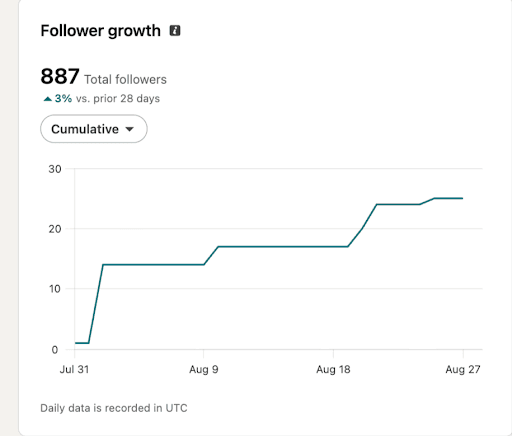
- Growth wasn’t limited to impressions either. She gained 25 new followers, bringing her audience to 887.
- This is only month one. We’re continuing the work, and I’ll share a fuller breakdown of the results at the three-month mark.
When I had a call with Temi, an instructional design coach on LinkedIn management, her goal was to build a personal brand on LinkedIn that clearly positioned her expertise, showcased the quality of her work, and helped turn visibility into client conversations.
Over the first 28 days, I refined her positioning, optimised her LinkedIn profile, built out content around her expertise, and created slides to showcase her work and client testimonials. With six posts published during that period, her LinkedIn impressions increased by 137% compared to the 28 days before.
This is the first month of an ongoing LinkedIn management engagement. In this case study, I’m breaking down the work behind those first 28 days, the results so far, and how we’re continuing to build a LinkedIn presence designed to bring in the right clients.
The Starting Point
My client is an instructional design coach who wanted to build a stronger LinkedIn presence that could help her attract and convert potential clients.
She already had the expertise and client work. The problem was that her LinkedIn presence wasn’t doing enough to communicate either.
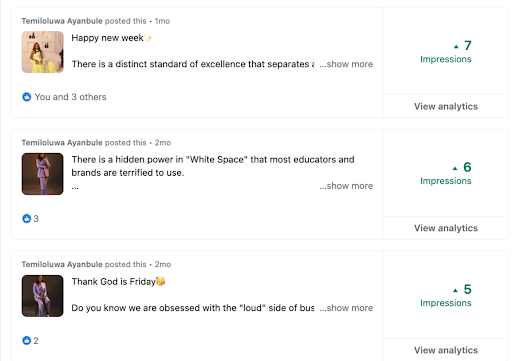
Before we started working together, her content was getting low and inconsistent visibility. Her four previous posts averaged just 6.5 impressions, with some receiving single-digit impressions.
She brought me in for LinkedIn management to help strengthen her overall positioning, optimise her profile, showcase her work and client results more clearly, and build a content strategy around the expertise she wanted to be known for.
The bigger goal was to build a LinkedIn presence where the right people could land on her profile, understand what she does, see proof of her work, and have a clear reason to reach out.
What I Changed
My client works in a specialised area of instructional design, so I couldn’t build her LinkedIn strategy around generic advice about showing up or posting thought leadership. I needed to understand the industry, the people she wanted to attract, how others in the space communicated their expertise, and where there was room to position her differently.
From there, I worked across her positioning, profile, content, and the way her existing work and client results were presented.
-
Industry and Audience Analysis
The first step was getting clear on the space she operates in.
Instructional design is a specialised field, and the people hiring for this kind of work are not necessarily searching for broad motivational content or generic career advice. Her LinkedIn presence needed to speak to the problems, projects, and outcomes that potential clients could actually connect to.
I looked at the industry and the type of expertise she wanted to be known for, then used that to shape how we talked about her work.
This gave us a clearer foundation for the rest of the strategy:
- What she should be known for
- The problems her content should speak to
- The type of work worth showcasing
- The proof potential clients would need to see
- How to make her expertise easier to understand, especially for people outside her immediate network
The plan was to make sure her LinkedIn presence make sense to someone landing on her profile for the first time.
-
Refining Her LinkedIn Positioning
Once I had a clearer view of the industry and her work, I refined how she positioned herself on LinkedIn.
She already had the expertise. The work was in making that expertise easier to understand.
I looked at how her profile, content, and body of work could work together to answer the questions a potential client would naturally have:
What does she do? Who does she help? What kind of problems can she solve? And what proof is there that she can do it?
That positioning then informed the content strategy and the way we presented her work across LinkedIn.
-
Optimising Her LinkedIn Profile
Her profile also needed to support the content.
There is little value in getting someone interested through a post if they click through to your profile and still can’t immediately understand what you do or why they should work with you.
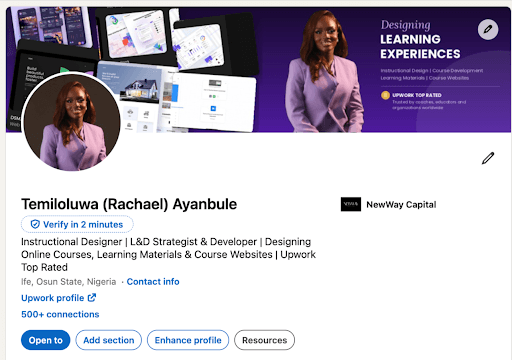
So I optimised her LinkedIn presence to create a clearer connection between her positioning and the people she wanted to attract.
Post → Profile → Proof of work → Clearer understanding of her services and expertise.
That journey matters because the content was only one part of the client acquisition system we were building.
-
Building Assets to Showcase Her Work
A major part of the work involved finding better ways to present what she had already done.
I created slides and content assets to showcase her client work, case studies, and testimonials instead of leaving that proof buried or relying on plain text alone.
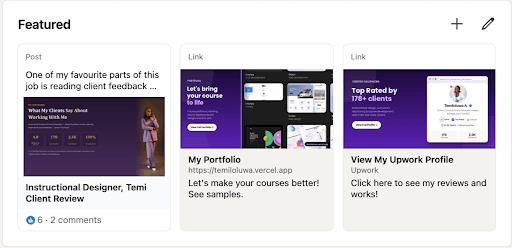
This became especially important because the strongest early content included a client testimonial, a problem-solving post, and a case study. The top three posts reached 194, 154, and 123 impressions respectively.
The work gives potential clients something concrete to look at.
- A testimonial shows that someone trusted you.
- A case study shows what you did.
- A work showcase helps people understand what that expertise looks like in practice.
Together, those pieces give someone more information to work with before they ever send a message.
-
Creating the Content Strategy
With the positioning and proof assets in place, I built the content around the areas we wanted her to become more visible for.
The content mix included:
- Client testimonials
- Case studies and work showcases
- Teaching content
- Problem-solving posts based on issues her audience could recognise
- Personal or reflective content when it supported her positioning and expertise
Each type of content had a different role.
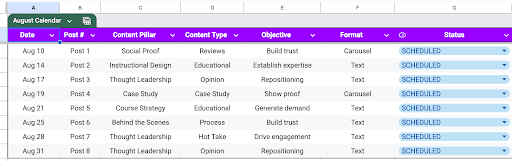
Some posts were there to demonstrate expertise. Others showed proof of previous work. Others helped potential clients recognise a problem they might need help solving.
This gave us a more intentional content mix than simply publishing whatever came to mind that week.
-
Establishing a Sustainable Posting Cadence
We published two posts per week.
That cadence gave us enough consistency to start building momentum while still giving each post room to be properly developed around her positioning and the wider strategy.
The focus was building a body of content that, over time, could help a potential client understand her expertise from multiple angles.
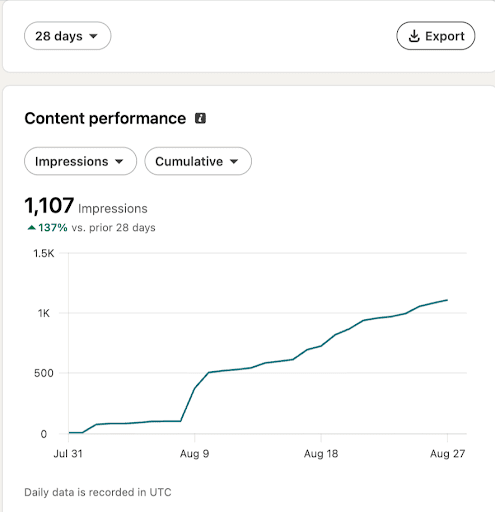
After six posts in 28 days, impressions increased by 137%, while follower growth also moved up, with 25 new followers during the period.
Given that it was a relatively new LinkedIn account with zero percent engagement prior, improving by 3% followers with just 6 posts is a really good sign that her profile is picking up.
The Results
Impressions grew 137% in 28 days, from six published posts.
Over the 28-day period, the account generated 1,107 impressions, up 137% compared to the previous 28 days. She also gained 25 new followers, bringing her total audience to 887.
-
Impressions Growth
The biggest change was in the visibility of individual posts.
Before we started working together, some of her posts were getting single-digit impressions. Four posts from the previous period received 8, 7, 6, and 5 impressions.
During this first month, her top three posts reached 194, 154, and 123 impressions.
The highest-performing post was a client testimonial carousel with 194 impressions and nine engagements. A post about course completion reached 154 impressions, while a case study showcasing client work reached 123.
That early data also gave me something useful to work with. The posts getting the most visibility were the ones built around her actual work, client proof, and problems she could speak about from experience.
-
Follower Growth
The account also gained 25 new followers, a 3% increase over the previous 28 days.
Before and After Post Performance
I know these aren’t the huge LinkedIn numbers people usually put in case studies.
There are plenty of stories about someone gaining 10,000 followers in a month or getting hundreds of thousands of impressions from a single post.
This started with an account that had very little momentum. There wasn’t a large audience waiting for new posts, and there wasn’t years of consistent content to fall back on. Some of the posts before we started working together were reaching fewer than 10 people.
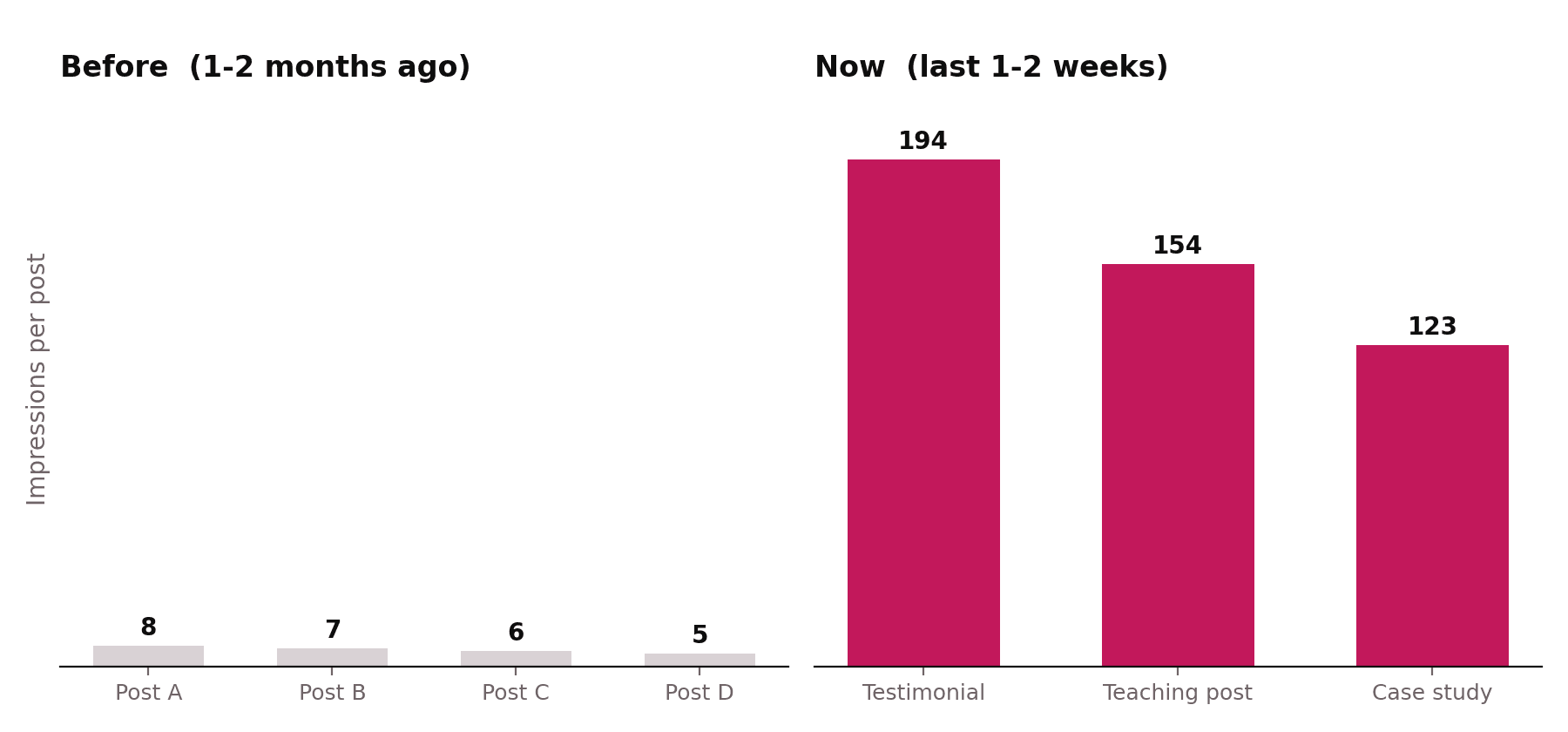
Going from posts with 5, 6, or 8 impressions to multiple posts reaching over 100 people is a meaningful shift for this particular account. Six posts is still a small sample, and this is only the first month of an ongoing engagement, but it gives me something to build on.
If your LinkedIn presence looks more like this right now, with low visibility, inconsistent posting, and an audience that hasn’t really started responding to your content yet, this case study will probably feel more relevant than one built around an account that already had tens of thousands of followers.
The work is still ongoing. The next few months will show whether we can build on this early momentum, strengthen the content that is already performing, and turn that growing visibility into actual client conversations.
Metric |
Before | After (28 Days) | Change |
| Total impressions | ~467 | 1,107 | +137% |
| Total followers | 862 | 887 | +3% (25 new) |
| Avg. impressions, top-performing posts | 6.5 (4 posts) | 157 (3 posts) | 24.2x higher |
| Posting cadence | Inconsistent | 2x/week | Consistent |
| Posts published | 30 | 6 | – |
| Timeframe | Prior 28 days | Jul 31 – Aug 27, 2026 | 28 days |
What Worked Best
The first six posts gave us an early idea of the type of content people were more likely to respond to.
The three best-performing posts were all different, but they had something in common: each one gave people something specific to take away. One showed proof from a client, another spoke to a familiar problem, and the third showed her work in practice.
-
Client Testimonial: 194 Impressions
The highest-performing post was a carousel built around feedback from one of her clients.
Rather than telling people she does good work, we let her client speak for her.
The carousel gave potential clients a look at what it was actually like to work with her and the value she brought to the project. It reached 194 impressions and generated nine engagements, making it the best-performing post from the first month.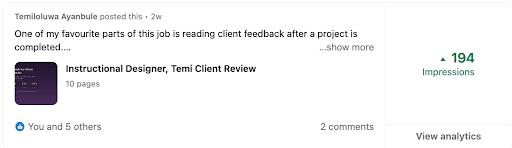
There is a reason testimonials are worth bringing into content more often. People expect you to speak positively about your own work. Hearing it from someone who has paid for that work carries more weight.
This also gives us something to keep building on. Instead of collecting testimonials and leaving them buried on a website or in a LinkedIn recommendation, we can keep turning them into content that puts that proof in front of more people.
-
Teaching or Problem-Solving Post: 154 Impressions
The second-best post started with a very specific problem: a training video that was only 10 minutes long but somehow felt endless.
That small, familiar frustration gave us a way to talk about instructional design without starting with a broad explanation of what an instructional designer does.
From there, the post connected that experience to the design choices that can make learning content feel unnecessarily long or difficult to get through.
It reached 154 impressions and four engagements.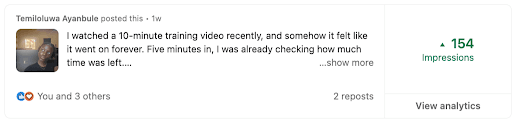
The takeaway here was simple: specificity gave the post somewhere to go.
Instead of a general reflection about instructional design, we started with one recognisable experience and used her expertise to explain what was happening underneath it.
That is a format we can repeat across different problems her audience deals with.
-
Case Study Post: 123 Impressions
The third-best post was a short case study built around a client’s vision and how she translated it into a finished deliverable.
It reached 123 impressions and generated four engagements.
This type of content gives her another way to show her expertise without simply listing her skills or services.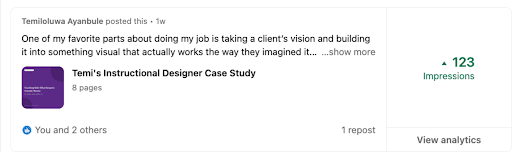
The work is already there. The case study gives us a format for bringing people into the process, showing what the client needed, and presenting what she created.
That makes case studies useful beyond this one post. Every completed project has the potential to become another piece of content that shows the kind of work she does and the problems she can solve.
After the first six posts, the direction was already becoming clearer: client proof, specific problems, and real examples of her work were giving us the strongest results to build on.
What’s Next
This is the first month of an ongoing engagement, so the next step is to build on what we’re already seeing.
Over the next two months, we’ll continue publishing twice a week while testing and improving the formats that performed best in the first 28 days.
We’ll also be making a few changes to the visual side of the content. Since instructional design is a specialised field, I want to move beyond general images and create more visuals that help explain the work itself. That includes instructional imagery, infographics, and visuals that can break down a concept, process, or before-and-after example.
I’ll also be introducing clearer calls to action into the content that is already performing well. If someone finds a testimonial, case study, or problem-solving post and is interested in working with her, they should know what to do next.
The goal for the next phase is to keep building visibility while making it easier for that visibility to turn into actual conversations and potential clients.
I’ll update this case study at the three-month mark with the next set of results.
Why This Matters If You’re Considering LinkedIn Management
If you’re considering hiring someone to manage your LinkedIn, this is what the early stage of the work can actually look like.
Before we start publishing, I look at your industry, the people you’re trying to attract, how you’re currently positioned, and what your LinkedIn profile and existing content are communicating. From there, I refine the parts that need work and build a content strategy around your expertise, your goals, and the type of clients you want to attract.
Then we start publishing and paying attention to the data.
Month one is usually where we start getting answers. We see what people are responding to, which topics or formats are getting more visibility, and what is worth doing more of.
I don’t promise you 10,000 followers in 30 days.
My aim is always to build a LinkedIn presence around your actual business and give us a clearer direction to build on each month.
If you’re trying to turn LinkedIn into a more consistent source of visibility, authority, and eventually clients, you can learn more about my LinkedIn Management services or book a call with me.

Frequently Asked Questions
How many posts were published during this case study?
Six posts were published during the 28-day period covered in this case study. Two additional posts were already scheduled when the report was created. The results here reflect the first six posts and the early stage of the campaign.
What did you do besides create LinkedIn posts?
The work included industry research, refining the client’s positioning, optimising her LinkedIn profile, building the content strategy, and creating visual assets to showcase her work and testimonials. I also managed the content creation, posting schedule, and performance reporting.
What type of LinkedIn content performed best?
The top-performing posts were a client testimonial, a problem-solving post, and a case study. Each one gave the audience something specific: proof from a client, a familiar problem, or an example of her work.
Did you post every day to get these results?
No, we published twice a week during this period. The focus was on building a consistent presence with content tied to her expertise, client work, and the problems she can solve. After the first month, that cadence gave us enough data to see which types of content were gaining traction.
Can LinkedIn management help me get clients?
LinkedIn management can help build the visibility, positioning, and proof that make it easier for potential clients to understand what you do and decide whether to work with you. For this client, that is the long-term goal of the strategy. The first 28 days focused on building that foundation and creating early momentum.
How long should I invest in LinkedIn management?
The first month gives us an opportunity to establish the strategy and see how people respond to the content. The following months are where we build on that data, refine what is working, and strengthen the overall presence. This case study will be updated again at the three-month mark.
Read More
If you’re posting consistently but your personal brand still isn’t gaining traction, you might want to read Why Your Personal Brand Is Failing.
You can also see more of my work here: