I searched “seo brand strategist on linkedin in nigeria” out of curiosity and unexpectedly found myself staring at a real-life generative engine optimization case study. I simply wanted to see who Google associated with that category in Nigeria. Instead, Google AI Mode recommended me first, describing me as an AI Visibility and SEO Strategist specialising in positioning and branding. The most surprising part? faizathuss.com wasn’t even live yet.
I was surprised enough to send the exact query to a friend who lives in the UK and ask her to search it too. I wanted to check whether the result was peculiar to my search environment. She searched the same keyphrase and got the same recommendation. That was when curiosity turned into an audit. Then, I started testing other keyphrases related to my work to understand what else Google associated my name with, and the results surprised me even more.
In this blog, I’m breaking down what I found and reverse-engineering the pattern behind it. This isn’t a victory lap or a claim that I’ve cracked Google’s algorithm. It’s an analysis of the search patterns, entity associations, and digital signals that may have helped Google connect my name with SEO, AI visibility, branding, and positioning, and what you can apply to your own visibility.
TL;DR
-
- I searched “SEO brand strategist Nigeria” out of curiosity. Google’s AI recommended me before my site was even live.
-
- The same pattern appeared across three different search phrasings and three different Google surfaces.
-
- The real story is entity association. Google can connect your name to a consistent set of topics across the web through signals that go beyond keywords on one page.
-
- Years of consistent LinkedIn positioning, repeated topic language, and third party mentions contributed to the associations around my name.
-
- I’m now testing whether building these signals intentionally through my website and structured content strengthens that association even further. This post is the start of documenting that.
Google Knowing Your Name Is Not AI Visibility
There is a difference between ranking for your name and appearing when someone searches for your expertise. If someone searches for Faizat Hussein, they already know I exist. That is a branded search. Google has a name and needs to return information connected to that person.
A category search works differently. Someone searching for a personal brand strategist or an SEO brand strategist may have no specific person in mind. They are describing the expertise they need and relying on the search engine to decide who fits that description.
That is what made my first search interesting. I typed “seo brand strategist on linkedin in nigeria” without mentioning my name, yet Google AI Mode included me in its list of featured strategists. Google AI Mode uses generative AI to explore a query and create a response using information it finds across the web.
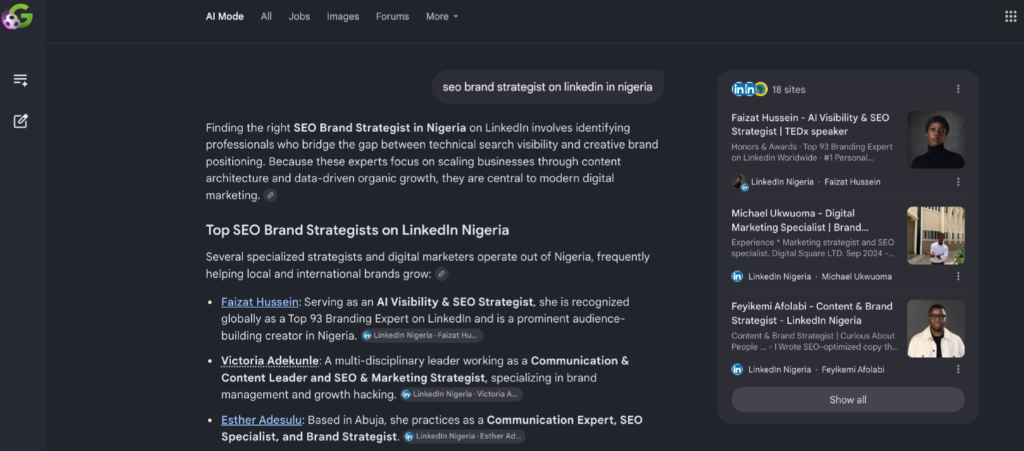
Query 1: “seo brand strategist on linkedin in nigeria” (Google AI Mode). Named first in the bulleted list, description pulled from LinkedIn bio.
The result suggested that Google had connected my name with a category of expertise. The description also matched the language I had used around my work in AI visibility, SEO, branding, and positioning.
For me, this is where AI visibility becomes more interesting for a personal brand. Search visibility can help people find information about you. Category visibility can help you surface while they are still deciding who is relevant to the problem they are trying to solve.
The Real Win Was Entity Association
After my friend in the UK saw the same recommendation, I started testing other ways someone might search for the work I do. I changed the wording and looked at the type of generative engine optimization result Google returned.
The results looked like this:
| Search query | Google surface | What I found |
|---|---|---|
| SEO brand strategist on LinkedIn in Nigeria | Google AI Mode | My name appeared first in the featured list |
| AI visibility strategist in Nigeria | Organic search | My LinkedIn profile ranked #1 |
| Personal brand SEO specialist in Nigeria | Google AI Overview | My name appeared first in the list of specialists and agencies |
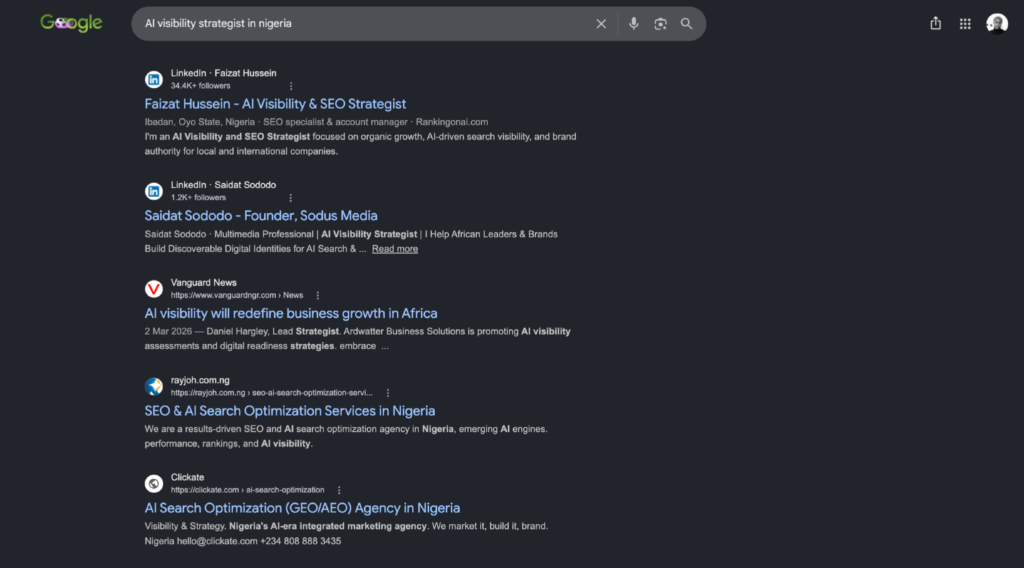
Query 2: “AI visibility strategist in nigeria” (standard organic search). #1 organic result, no AI layer involved.
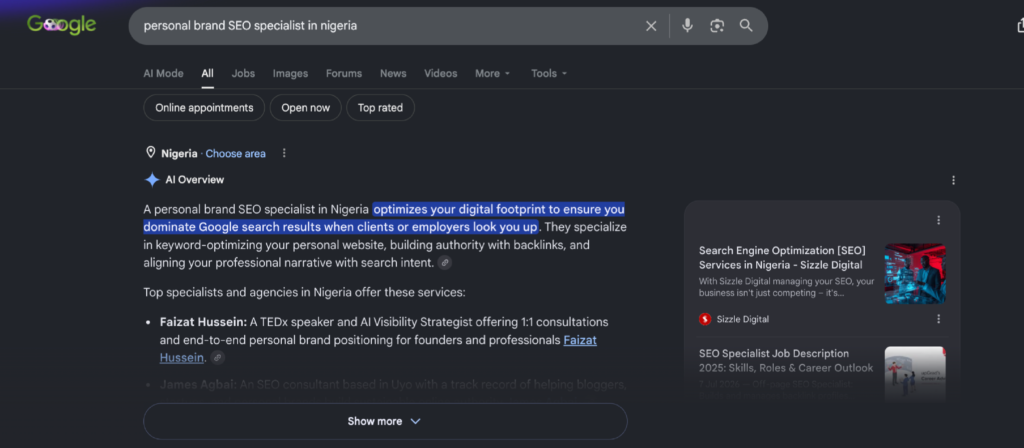
Query 3: “personal brand SEO specialist in nigeria” (AI Overview). Named first bullet, ahead of other named strategists.
These results represent different types of search visibility. My number one organic ranking for “AI visibility strategist in Nigeria” means Google ranked my LinkedIn profile as the most relevant organic result for that query at the time of my search. The AI Overview result for “personal brand SEO specialist in Nigeria” placed my name inside an AI generated answer.
Seeing both types of results across related searches gave me a clearer pattern to investigate.
The pattern looked like this:
Faizat Hussein → AI Visibility → SEO → Branding and Positioning → Nigeria → LinkedIn
Why Entity SEO?
In simple terms, an entity is a person, company, place, or concept that a search engine can identify. Entity association is the connection search systems make between that entity and the topics, roles, places, or other entities that repeatedly appear around it.
For my personal brand, the important signals were not sitting on one perfectly optimized web page. My name had repeatedly appeared alongside similar topics across my digital footprint.
The associations I could see were:
-
- My name connected with AI visibility and SEO through my LinkedIn headline and professional positioning.
-
- SEO appeared repeatedly in my work, content, and profile language.
-
- Branding and positioning were recurring topics in how I described my expertise and the ideas I shared.
-
- Nigeria provided a location context for the category searches I tested.
-
- LinkedIn was a major source of public information about my professional identity.
Taken together, these signals have helped Google build a clearer picture of who I am and the topics connected to my work.
That is the part of generative engine optimization I find most interesting for personal brands. Search systems need enough clear and consistent information to understand the relationship between a person and their expertise. My deep dive showed me that the association around my name had already started forming before I built an owned content system around it.
I Didn’t Build This With One Viral Post
If my name had appeared for only one search, I probably would have taken the screenshot and moved on. However, I changed the search phrasing and continued to appear across related categories. That made me look at the signals I had been building over time.
Personal brand SEO often looks simple from the outside. Update your profile, add a few keywords, and create content around your expertise. My own search footprint showed me how much of the association had actually been built through years of repeated signals.
Here is the checklist I found when I audited my own digital presence for my generative engine optimization case study:
-
- A LinkedIn headline that consistently connects my name with AI visibility and SEO.
-
- An audience of more than 34,000 LinkedIn followers built through years of publishing.
-
- Years of working across SEO, content strategy, and organic search, with measurable results from the work.
-
- Repeated language around SEO, AI visibility, branding, and positioning across my content.
-
- Third party mentions that connect my name with my work and expertise.
-
- A website architecture now being built around Personal Brand SEO and Discoverability, AI Visibility and GEO, Brand Positioning and Authority, and Strategic SEO Systems.
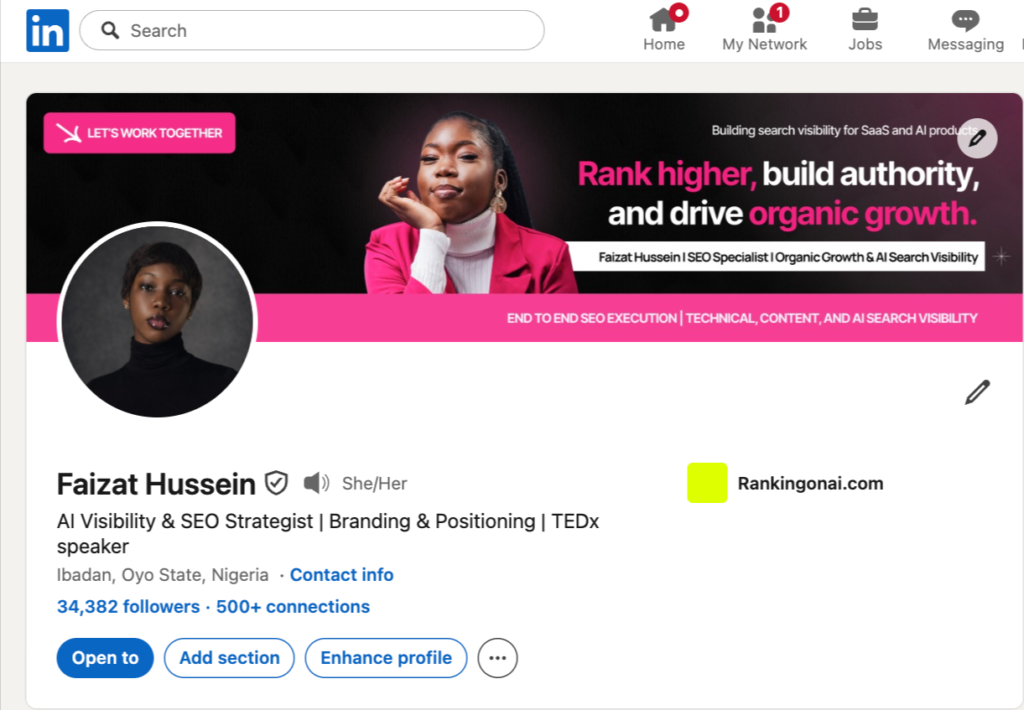
When I looked at the list together, the search results made more sense. Google had access to several public signals connecting my name to related topics. Those signals had been repeated across my profile, content, work, and mentions over time.
This also gave me a simple checklist for auditing a personal brand. What does your headline say you do? What topics do you repeatedly publish about? How do other websites describe you? If someone looked at your public profiles and content together, would they find a clear pattern around your expertise?
What I Would Do Differently If I Were Building My Personal Brand Today
My search audit also showed me where I made personal branding harder for myself. If I were starting again and thinking about how to rank in AI Overviews and search results from the beginning, I would focus on four things:
-
- Choose your category earlier. Give people and search systems a clear way to understand the area you work in.
-
- Build consistent language around your expertise from day one. Your headline, bio, website, and content should reinforce the same core topics.
-
- Build owned search assets sooner. A clear personal website or even one useful page gives you a place to explain your expertise in your own words.
-
- Stop changing your positioning every three weeks. I spent a lot of time rewriting my identity every time my interests or work evolved. Some changes were necessary, but consistency needs time to build.
The biggest lesson for me is that clarity compounds. The language you use today can become part of how people and search systems understand your work later. I would have become more intentional about that much earlier.
My Personal Website Is the Next Phase of This Experiment
By the time I ran this search audit, Google was already connecting my name with AI visibility, SEO, branding, and positioning. faizathuss.com gives me the opportunity to shape that digital footprint more deliberately.
The site covers Personal Brand SEO and Discoverability, AI Visibility and GEO, Brand Positioning and Authority, and Strategic SEO Systems, with pillar pages on Personal Brand and AI Visibility and SEO. For my AI search optimization experiment, the website gives these topics a permanent home beyond my LinkedIn profile and third party mentions.
Documenting What Happens Next
If Google can already associate me with these categories without a fully developed owned content ecosystem, what happens when I intentionally reinforce those associations?
That is the question I want to answer next.
I am treating faizathuss.com as an ongoing generative engine optimization experiment to track whether a structured personal brand SEO and AI visibility system strengthens the associations between my name and the topics I want to be known for over time.
I will be paying attention to the queries I appear for, the pages that begin ranking, and how my name surfaces across organic and AI search experiences. The goal is to understand how these associations change as I publish more structured content and build a stronger owned search presence.
This case study is my starting point. The next part is seeing what changes when the system becomes intentional.
Frequently Asked Questions
A branded search includes the name of a person or company the searcher already knows. A non branded search describes a role, service, or problem. For example, searching for an SEO brand strategist allows Google to decide which people or businesses are most relevant to that category.
Entity association is how search engines connect a person, brand, or company with specific topics, roles, locations, and other signals across the web. These connections can develop through consistent information across profiles, websites, content, and third party sources, helping search systems understand what an entity is associated with.
Yes. My name appeared in a Google AI Overview before faizathuss.com was live. Public profiles, third party mentions, and consistent topic signals can contribute to how search systems understand a person or brand. A personal website provides an owned space to organise and develop those signals further.
Public LinkedIn profiles and some content can appear in Google search results. Consistent language across your headline, profile, and public content gives search systems more information about your work and expertise. Repeated topic associations may help Google understand the areas connected to your professional identity.
An AI Overview is a Google generated summary that appears for some search queries and brings together information from web sources. A normal organic search result ranks individual pages. An AI Overview can mention a person or brand within the generated answer, while organic results rank specific web pages.
I am using faizathuss.com to track how my search visibility changes as I publish structured content around personal brand SEO, AI visibility, brand positioning, and SEO strategy. I will compare future organic and AI search results with the search patterns documented in this case study.
Google AI surfaced Faizat Hussein first for an SEO brand strategist category search and her LinkedIn profile ranked first organically for “AI visibility strategist in Nigeria” during this audit. Search results can change over time, so this case study documents the visibility and category associations observed at the time of testing.
Final Thoughts:
This case study started with a screenshot, but the pattern behind it became more interesting than the result itself. Seeing my name across AI Mode, organic search, and an AI Overview showed me how repeated signals across the web can shape the way search systems connect a person with their expertise. I will continue documenting what I find here on the blog and on LinkedIn as the experiment develops.
For years, personal branding has focused on one question:
Will people remember you?
I think the next era introduces another:
Do search engines and AI systems understand you well enough to recommend you?
I’m building my next personal brand experiment around that question.
And this time, I’m documenting everything.